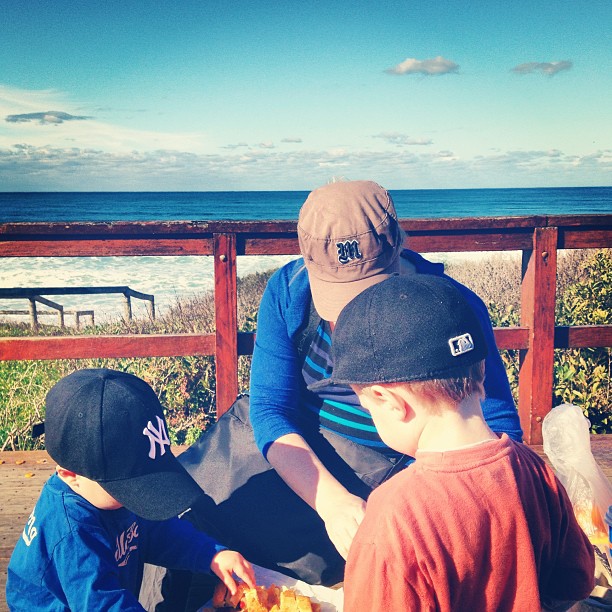
We’re using this video at SOULIES tonight to tie in with a talk I’m giving on Luke 14:
See more ‘persecution‘ posts

DAVEMIERS.COM
We’re using this video at SOULIES tonight to tie in with a talk I’m giving on Luke 14:
See more ‘persecution‘ posts
This post has nothing to do with today, a Sunday! It’s been a good day. For the younger crowd reading this, Sunday Bloody Sunday is a well-known U2 song (U2 is a band). Find out more about the historical background to the song here.
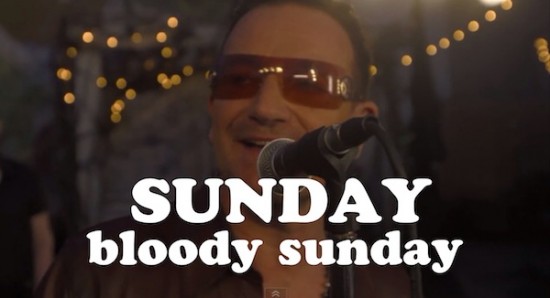
Last week, on a rooftop in New York City, the band recorded an acoustic performance of ‘Sunday Bloody Sunday’ – and dedicated it to democracy in Iran.
The track is part of ONE’s campaign to harness the power of protest songs to demand action against extreme poverty at the G8 summit. (Read more about it here) Check the vid:
Check out the latest spoken word vid by Jefferson Bethke. See previous ones here.
Did God die on the cross? Good question. At least one popular preacher has a chapter of a book and a sermon entitled “GOD DIES” when dealing with the cross. But is that accurate? I’ve heard a number of younger guys speak of the cross in that way, but I’m not convinced that God did die on the cross. Below is an extract from Dr. R.C. Sproul’s tremendous little book The Truth of the Cross. In the final chapter Sproul has a Q+A section dealing with some tricky questions about the cross. I like his response for this question.
———-
The famous hymn of the church “And Can it Be?” contains a line that asks a very poignant question : “How can it be that thou, my God, shouldst die for me?” Is it accurate to say that God died on the cross?
This kind of expression is popular in hymnody and in grassroots conversation. So although I have this scruple about the hymn and it bothers me that the expression is there, I think I understand it, and there’s a way to give an indulgence for it.
We believe that Jesus Christ was God incarnate. We also believe that Jesus Christ died on the cross. If we say that God died on the cross, and if by that we mean that the divine nature perished, we have stepped over the edge into serious heresy. In fact, two such heresies related to this problem arose in the early centuries of the church: theopassianism and patripassianism. The first of these, theopassianism, teaches that God Himself suffered death on the cross. Patripassianism indicates that the Father suffered vicariously through the suffering of His Son. Both of these heresies were roundly rejected by the church for the very reason that they categorically deny the very character and nature of God, including His immutability. There is no change in the substantive nature or character of God at any time.
God not only created the universe, He sustains it by the very power of His being. As Paul said, “In Him we live and move and have our being” (Acts 17:28). If the being of God ceased for one second, the universe would disappear. It would pass out of existence, because nothing can exist apart from the sustaining power of God. If God dies, everything dies with Him. Obviously, then, God could not have perished on the cross.
Some say, “It was the second person of the Trinity Who died.” That would be a mutation within the very being of God, because when we look at the Trinity we say that the three are one in essence, and that though there are personal distinctions among the persons of the Godhead, those distinctions are not essential in the sense that they are differences in being. Death is something that would involve a change in one’s being.
We should shrink in horror from the idea that God actually died on the cross. The atonement was made by the human nature of Christ. Somehow people tend to think that this lessens the dignity or the value of the substitutionary act, as if we were somehow implicitly denying the deity of Christ. God forbid. It’s the God-man Who dies, but death is something that is experienced only by the human nature, because the divine nature isn’t capable of experiencing death.
———-
Extract from R.C. Sproul, The Truth of the Cross.
Originally posted here.
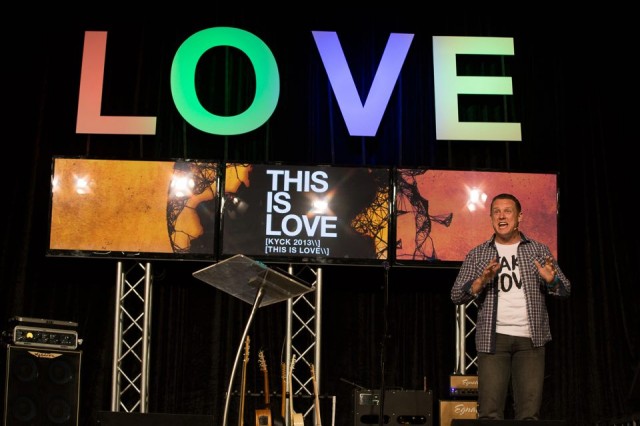
Sydney Anglicans recently ran an article on KYCK 2013. I missed posting about it while I was away. So here it is. The pic is from KYCK Facebook page. See below for a snippet…
This year’s Katoomba Youth Christian Convention, known as KYCK, totalled roughly six thousand delegates over the three weekends and saw some 900 young people either become a Christian for the first time, or recommit themselves to following Christ.
The theme of this year’s convention, which concluded last weekend, was This is Love, focusing on the book of 1 John through six talks.
One of the two speakers at the convention, St Faith’s Narrabeen youth pastor Dave Miers, says that he was overjoyed by the response from many of the youth, and hopes to see them continue to follow Christ in the months and years ahead.
Click here to see the whole article, including some of my quotes.